BEWARE OF SPOILERS
The Banshee by Henry Cowell
Jane wakes up in the middle of the night to a sense of foreboding…
And then she hears the groaning, shrieks and creepy laughter of Mrs. Rochester as she sets her husband on fire.

Imagining books and music in quirky and creative ways
BEWARE OF SPOILERS
The Banshee by Henry Cowell
Jane wakes up in the middle of the night to a sense of foreboding…
And then she hears the groaning, shrieks and creepy laughter of Mrs. Rochester as she sets her husband on fire.

I have recently been nominated for two blogger awards: the Liebster (I love how that just autocorrected to Lobster) and the One Lovely Blog award, so I’m just going to tackle them both in one post!
But first of all, thanks so much to Erika Kind (Liebster) and Susanne Valenti (One Lovely Blog) for the nominations!

So here are 7 (quirky) facts about myself:
1) At my 16th birthday party, I accidentally set my hair on fire. My mother and friends had just finished singing Happy Birthday to me when it fell into the candle flames on my birthday cake. I was concentrating so hard on blowing out all 16 candles in one breath that I didn’t even notice…I just saw my friends staring at me with wide eyes and heard my mom shouting my name and clapping her hands against my hair. Oops.
2) Freshman year of my undergraduate experience my roommate and I teamed up to kidnap our friend’s mannequin. Where we left ransom notes, he responded with Pulp Fiction quotes thrust under our door. But hey, he started it by scaring me half to death with that mannequin just chilling in our shower. So I have no regrets. (P.S. for those of you who may be wondering, we did–of course–eventually give it back.)
3) A tree frog jumped on my face once in elementary school. We were Continue reading “7 Quirky Things About Me + 11 Questions Answered”
At last we come to the final movement. But first, let’s indulge in a quick recap:
So now we come to the fifth and final movement. What is Grieg going to leave us with? Continue reading “Classical Music Stories #1: Anna Karenina (Part 5)”
Holberg Suite, Op. 40: IV. Air (Andante religoso) by Edvard Grieg
Hold onto your hats, kids, because the hint of tragedy that was in the second movement is in full force now. We hear a pervasive hopelessness and what sounds like a struggle against something unchangeable (…hence the hopelessness). Plus, when the music comes back to repeat, it’s even sadder and more disillusioned, just like Anna after she gives birth to Vronsky’s child and thinks she’s dying.
(2:55) But then things become much more tender and hopeful (definitely a welcome surprise after all of this depressing music). It’s like when her husband, Alexei Alexandrovitch comes to visit her. Now that she’s sick he’s the only one Anna wants—the only one who can break her out of her own misery and self-pity (a.k.a. all the music up to this point).
(3:27) All of which leads quite Continue reading “Classical Music Stories #1: Anna Karenina (Part 4)”

Holberg Suite, Op. 40: III. Gavotte (Allegretto) by Edvard Grieg
General Story:
This movement sounds like a sophisticated, formal ball to me. I can just picture the nobility in their fancy suits and ball gowns as they dance the evening away.
(1:21) Then the music switches to two Continue reading “Classical Music Stories #1: Anna Karenina (Part 3)”
I’ve dealt with this idea a little in previous posts, but now I want to address it head-on:
classical music tells a story.
It has characters and actions, plot twists and classic endings, heroes and villains. Of course, since music is so abstract it doesn’t tell a specific story (most of the time). But that doesn’t mean that you can’t use your imagination to hear one if you want to.
I think the simplest way to think about it is to imagine that the piece you’re listening to is actually the score of a movie adaptation of a book. I know, I know, books turned into movies aren’t always the best…but here’s your chance to do it correctly inside your head. Who would the characters be? What would they be doing? You’re basically Continue reading “Classical Music Stories #1: Anna Karenina (Part 1)”
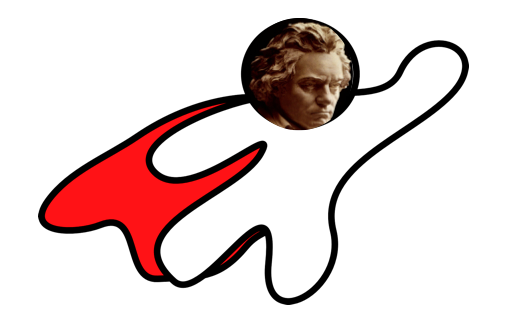 Ludwig van Beethoven: Mind control
How else could he have ignited the fierce battle that took place between Brahms and Wagner? They were both so obsessed with pursuing Beethoven’s legacy that they must have been under his power.
But before you go thinking he’s a supervillain like Loki, he also wrote some pretty different music that stretched the boundaries of what was acceptable at that time, and everyone loved it. We still love it today. So he used his powers for good, too (wait…could we still be under his superhuman influence??).
W.A. Mozart: Super speed Continue reading “Did You Know That Classical Composers Were Superheroes?”
In classical music, there’s a good chance that you’ll hear the opening music return at the end. It might be: A) literally repeated note for note or B) altered in some way (but let’s keep this second type under the “repetition” umbrella, too, for simplicity’s sake).
TIME OUT for a delicious food analogy:
Opening and closing music = outer donut Middle music = custard filling
Okay, so why do composers repeat the opening music?
Well for one thing, I think music sounds differently each time it comes back, even if it’s repeated note for note. It’s like when
you go on vacation. You start out at home, go someplace else for a while, and then return home. I don’t know about you, but home always feels different by the time I get back (sometimes in a good way and sometimes in a not so good way if I really enjoyed the vacation).

John Cage’s Sonata 12 is what I imagine a child’s larks and a parent’s lullaby would sound like within George Orwell’s 1984.
What would it be like for a parent to sing his or her child to sleep, knowing that that same child will report him or her to the Thought Police at the slightest sign of dissension? What would it be like knowing that your own progeny would more likely than not send you to a swift and horrible death? It is incredible to imagine the mixture of parental love and crippling fear that must be felt for the tiny creature in such circumstances.
When I listen to Cage’s piece, I imagine the beginning and ending to present the parent who is watching his or her child play nearby. The music is playful and lilting as the child frolics around, but at the same time definitely unhinged because that innocence is a façade for something much darker. In the middle, the parent sings the child to sleep with a lullaby and gazes on his or her face that is made to appear so innocuous by sleep.
Can you hear it?
 If Mermaids Wore Suspenders